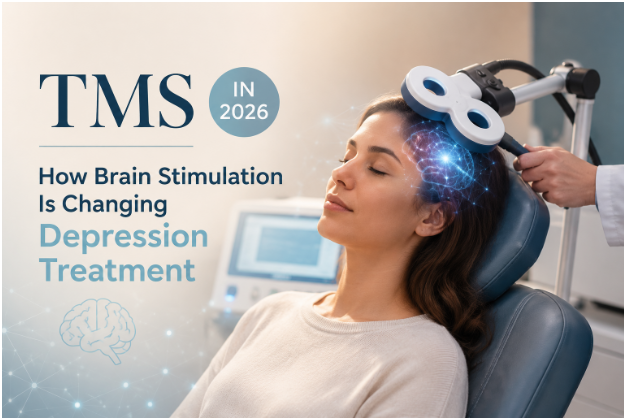
Major Depressive Disorder (MDD) affects millions of people across the United States and worldwide. For many, the path to meaningful improvement can be long, often involving trial-and-error with medications, therapy, or traditional repetitive transcranial magnetic stimulation (rTMS) delivered once daily over several weeks. Now, there is an option that can compress effective treatment into days rather than weeks. MagVenture has received FDA clearance for Accelerated Transcranial Magnetic Stimulation (aTMS), and this development expands the tools Irvine Psychiatry and TMS can offer patients living with MDD.
In this article we explain what aTMS is, how it differs from traditional TMS, what a typical treatment course looks like, who may benefit, and how to consider aTMS as part of a comprehensive depression care plan. We’ll also explore the important link between physical pain and emotional pain, because addressing both is the best way to improve outcomes for patients with depression.
What is Accelerated TMS (aTMS)?
Transcranial magnetic stimulation (TMS) is a noninvasive neuromodulation therapy that uses magnetic pulses to stimulate targeted regions of the brain involved in mood regulation.
Conventional TMS protocols typically deliver a single daily session, weekday visits for 4-6 weeks using either high-frequency repetitive TMS (rTMS) or intermittent theta burst stimulation (iTBS).
Accelerated TMS applies the same FDA-cleared TMS protocols but compresses treatment by delivering multiple sessions per day across a shorter overall timeframe. Rather than spreading treatment across several weeks, aTMS organizes sessions into a treatment window that usually lasts 5-15 days, depending on the protocol and clinical plan. The goal is the same, normalize dysfunctional circuits associated with depression, but with faster delivery of cumulative stimulation.
How accelerated protocols work in practice
The new FDA clearance supports a flexible approach clinicians can tailor to a patient’s needs.
Typical elements include:
Multiple sessions per day: Treatment regimens range from 2 to 10 sessions daily, allowing clinicians to achieve the required dose more quickly.
Pulses per session: Each session usually delivers between 600 and 1,800 pulses. Pulses are the individual magnetic stimulations that modulate neural activity.
Inter-session intervals: Sessions are separated by 15-50 minutes to allow short recovery windows between stimulations.
Overall schedule: The condensed course typically spans 5–15 days, compared with 4-6 weeks for standard daily TMS.
Protocol compatibility: aTMS uses the same FDA-cleared rTMS and iTBS protocols already proven effective for MDD.
Navigation options: aTMS can be done with or without MRI-guided neuronavigation depending on clinical preference and available equipment.
Why accelerate treatment?
There are several advantages to accelerated delivery:
Speed of symptom relief: For many patients, faster symptom reduction is a critical clinical and practical benefit. In acute situations such as severe depression with suicidal thoughts or marked functional decline a faster-acting therapy can be lifesaving.
Reduced burden of time: Condensing treatment into days reduces the duration of repeated clinic visits over months, which can be a major barrier for people with busy schedules, caregiving responsibilities, or transportation challenges.
Improved adherence: Shorter overall treatment windows can increase the likelihood patients complete the recommended course, which supports better outcomes.
Rapid response for nonresponders: aTMS may be advantageous for patients who have not responded to medication trials or who need quicker evaluation of a neuromodulation strategy.
Who is a candidate for aTMS?
aTMS is intended for adults diagnosed with Major Depressive Disorder who are appropriate candidates for TMS. Potential candidates include:
People with moderate-to-severe depression who did not achieve adequate response with antidepressant medications or psychotherapy.
Individuals who need a faster approach due to symptom severity or life circumstances.
Patients who prefer a short, intensive course rather than daily visits for several weeks.
As with all medical treatments, candidacy is determined through a comprehensive clinical assessment that considers medical history, psychiatric comorbidities, seizure risk, presence of metal implants, and concurrent medications. At Irvine Psychiatry, we follow evidence-based screening protocols to ensure safety and maximize likelihood of benefit.
Efficacy and safety: what the evidence shows
The same stimulation protocols used in aTMS (rTMS, iTBS) have robust evidence supporting their use in MDD. Accelerated protocols are an emerging area of research: studies and clinical experience indicate many patients can achieve meaningful symptom relief faster when aTMS is used, though response varies by individual. The FDA clearance reflects that manufacturers have demonstrated aTMS delivery is safe when performed under specified conditions.
Common side effects mirror those of standard TMS: mild scalp discomfort or headache during or after treatment, transient fatigue, and rare risk of seizure (low but present). Clinicians minimize risk by adhering to safety guidelines, choosing appropriate stimulation parameters, and monitoring patients closely during sessions.
What to expect during aTMS at Irvine Psychiatry and TMS
If you are referred for aTMS, here’s a typical patient journey:
Consultation and evaluation: You come into the clinic for a full evaluation. Dr. Creighton reviews your psychiatric history, medication profile, and potential contraindications to TMS.
Individualized treatment plan: Based on your clinical presentation, we select rTMS or iTBS protocol, number of daily sessions, pulse counts, and overall schedule.
Orientation session: You’ll meet the treatment team, learn what to expect, and undergo baseline assessments of mood and functioning.
Treatment days: Sessions last 20-40 minutes each depending on protocol. Breaks of 15-50 minutes occur between sessions. Patients relax in a comfortable chair during treatment and are observed by staff.
Monitoring and follow-up: Mood, side effects, and functioning are assessed throughout and after the course to guide ongoing care.
Integrating aTMS into comprehensive care
aTMS is most effective when integrated into a broader treatment strategy that can include psychotherapy, medication management, lifestyle interventions, and supports for sleep, nutrition, and activity. Rapid improvements from aTMS can create a window in which psychotherapy and behavioral changes become more feasible and effective.
Addressing cost and access
Insurance coverage for TMS (including aTMS) differs across plans and is evolving. Some payers cover FDA-cleared TMS for treatment-resistant depression under specific criteria. Our administrative team at Irvine Psychiatry and TMS can assist patients with benefits verification, prior authorization where needed, and exploring financing options.
When to consider immediate care
If you or someone you care about is experiencing active suicidal ideation, severe psychomotor slowing, inability to perform basic self-care, or other signs of a psychiatric emergency, please seek immediate help: call local emergency services or the nearest emergency department.
Accelerated TMS may be part of urgent treatment planning for some patients, but emergency-level care should be the first step when risk is imminent.
SHARE pOST:
RECENT POST: